Auto news Honda: the latest models, updates, and industry insights
Auto news Honda: the latest models, updates, and industry insights
Honda is entering a decisive phase. The Japanese automaker still builds cars with the reassuring precision of a well-adjusted engine, but the industry around it is changing faster than a traffic light in Tokyo. Electrification, software, stricter emissions rules and cautious consumers are all reshaping the road ahead.
For Honda, the strategy is neither a blind sprint toward battery-electric vehicles nor a retreat into the combustion past. Instead, the brand is balancing hybrids, new electric models and familiar nameplates that continue to generate serious showroom traffic. The result is a product range in transition—part proven formula, part technological experiment.
So, what is new at Honda, which models deserve attention, and what do the company’s decisions reveal about the wider auto industry? Let’s take a tour through the latest Honda news, with the imaginary key already in the ignition.
Honda’s hybrid comeback gains momentum
The most important recent development in Honda’s lineup is the renewed focus on hybrid powertrains. While many manufacturers have rushed toward fully electric vehicles, Honda is betting that hybrids will remain a practical bridge for drivers who want better fuel economy without changing their entire driving routine.
The 2025 Honda Civic Hybrid is a good example of this approach. Available in sedan and hatchback formats, it combines a gasoline engine with Honda’s two-motor hybrid system. The technology is designed to deliver strong efficiency in urban driving while retaining the familiar character of the Civic.
That matters because the Civic is not just another compact car. It is one of Honda’s most recognizable products, a model with decades of history and a loyal audience ranging from first-time buyers to enthusiasts who still believe a manual gearbox is a form of mechanical poetry.
The Civic Hybrid also benefits from an important engineering detail: Honda’s system can operate primarily through electric drive at lower speeds, while the gasoline engine takes over more directly when conditions demand it. The result is smooth acceleration, reduced fuel consumption and fewer visits to the pump.
-
Civic Hybrid: improved efficiency with familiar Civic practicality.
-
CR-V Hybrid: a strong fit for families seeking space and lower fuel costs.
-
Accord Hybrid: a refined option for long-distance commuters and business drivers.
-
Upcoming hybrid expansion: Honda plans to make hybrid technology more central across its core vehicle range.
Honda has indicated that its next-generation hybrid systems should be more compact, lighter and more cost-effective to produce. That final point is crucial. A clever powertrain is impressive; a clever powertrain that can be built profitably is even better.
The CR-V remains the family workhorse
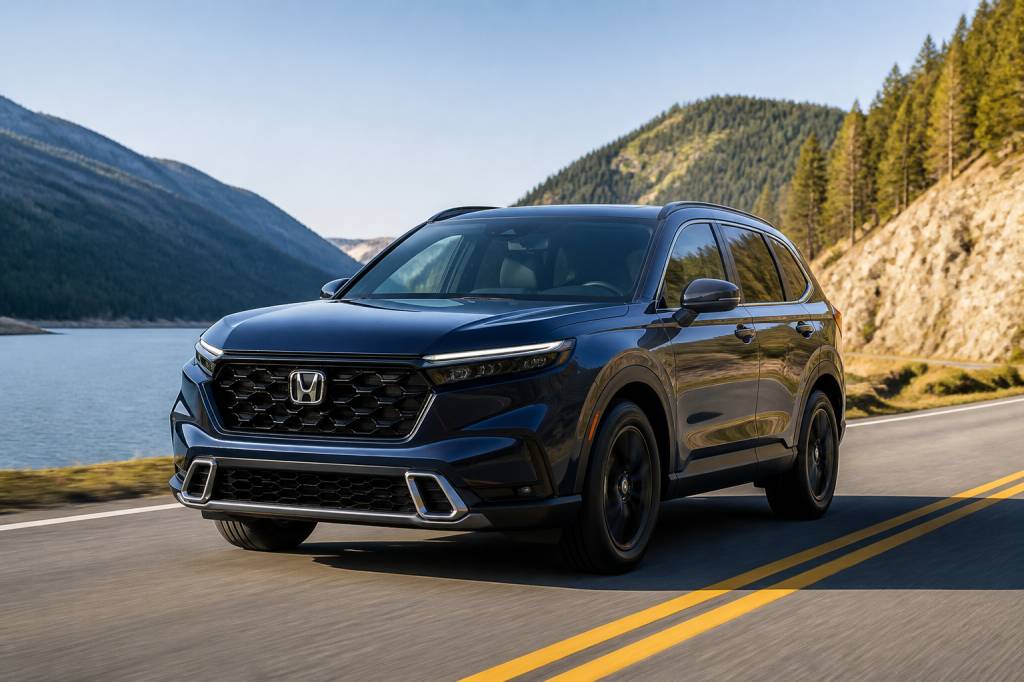
The Honda CR-V continues to occupy a central position in the company’s global strategy. It is spacious, comfortable and easy to live with—three qualities that rarely make spectacular headlines but frequently determine which vehicle ends up in a customer’s driveway.
The latest CR-V offers gasoline and hybrid versions, along with all-wheel drive on selected configurations. Its interior has a clean, practical layout, and the driving experience is deliberately calm rather than theatrical. It does not shout for attention; it simply gets on with the job.
For many buyers, that is precisely the appeal. The CR-V can handle school runs, weekend luggage, highway miles and the occasional muddy parking area without demanding a lifestyle makeover. It is the automotive equivalent of a reliable multitool, only with heated seats.
The hybrid model is especially important as fuel prices and emissions regulations continue to influence purchasing decisions. Drivers may not be ready for a full electric vehicle, but they increasingly expect better efficiency from an SUV. Honda’s hybrid CR-V gives them that option without requiring charging infrastructure at home.
Honda is also developing a hydrogen fuel-cell version of the CR-V in limited markets. The CR-V e:FCEV combines plug-in capability with hydrogen fuel-cell technology, creating an unusual dual approach. It can operate as a battery-powered vehicle for shorter trips and use hydrogen for longer-distance driving. The concept is technically intriguing, although hydrogen availability remains a major obstacle for widespread adoption.
Prologue puts Honda into the electric SUV race
Honda’s first major modern battery-electric vehicle for North America is the Prologue, an electric SUV developed through a partnership with General Motors. It uses GM’s Ultium platform but carries Honda-specific styling, tuning and interior design.
The Prologue is positioned as a practical, family-oriented electric vehicle rather than a radical technology statement. Its strengths include a quiet cabin, useful passenger space, available all-wheel drive and a driving range that makes it suitable for everyday commuting and road trips, depending on configuration and conditions.
Its arrival is significant because Honda has historically moved more cautiously than some competitors in the battery-electric market. The Prologue allows the company to establish a presence while its own dedicated EV architecture continues to develop.
There is an important business lesson here. Automotive development is expensive, and electric platforms require enormous investment in batteries, software, manufacturing and charging ecosystems. Partnerships can reduce risk and accelerate product launches. The downside is that the manufacturer gives up some control over the technical foundation.
For customers, the key questions are straightforward:
-
How easily can the Prologue be charged on long journeys?
-
Does its real-world range match the driver’s daily needs?
-
How competitive are lease offers and ownership costs?
-
Will Honda’s software and charging experience feel polished enough against newer EV specialists?
The Prologue is not intended to be the final word on Honda electric vehicles. It is more like the opening lap. The interesting part is what comes next.
Honda 0 Series: a new electric identity
At CES 2024, Honda introduced its 0 Series electric vehicle concept with the Saloon and Space-Hub prototypes. These vehicles presented a more futuristic design direction than the current Honda lineup, with slim bodies, lounge-like interiors and a strong focus on software.
The Saloon concept, in particular, suggests that Honda wants its future EVs to feel different rather than simply look like gasoline cars with batteries underneath. The design is low, aerodynamic and unmistakably experimental. Whether every dramatic feature reaches production is another question—concept cars are famous for wearing very fashionable shoes that never make it to the dealership.
Honda has said that the 0 Series will focus on several principles:
-
Thin and light engineering: reducing vehicle weight to improve efficiency and driving dynamics.
-
Advanced software: using over-the-air updates and improved digital services.
-
Human-centered interiors: creating more open, flexible spaces rather than simply adding screens.
-
Improved aerodynamic performance: extracting more range from every kilowatt-hour.
-
Driver assistance: expanding automated driving features while keeping the driver involved.
Production versions of the 0 Series are expected to begin arriving in the second half of the decade, with North American manufacturing plans linked to Honda’s wider battery and EV investment strategy. The timing will be important. By then, Honda will face stronger competition from Tesla, Hyundai, Kia, Toyota, Ford, Volkswagen and a growing number of Chinese manufacturers in global markets.
Honda’s electrification strategy is changing shape
Honda previously set ambitious global targets for battery-electric and fuel-cell vehicles. However, changing market conditions have encouraged the company to adjust its pace. EV demand has continued to grow, but not always as quickly as manufacturers expected. High interest rates, charging concerns, battery costs and uneven government incentives have made customers more selective.
That does not mean Honda is abandoning electric vehicles. It means the company is trying to avoid putting every technological egg in one very expensive battery basket.
Hybrid vehicles offer immediate advantages. They use existing fueling networks, can be sold through established dealerships and generally require less behavioral change from customers. They also allow manufacturers to reduce emissions while continuing to serve drivers who are not ready for a fully electric vehicle.
From a business perspective, this flexibility may prove valuable. Automakers must satisfy regulators while protecting margins, and the two goals do not always arrive at the same intersection. Honda’s strategy is increasingly based on a mixed lineup: hybrids for volume, EVs for the future and combustion models where demand remains strong.
What is happening with Honda’s core models?
The Accord remains Honda’s traditional midsize sedan flagship in North America. Its clean design, spacious cabin and available hybrid powertrain make it one of the more rational choices in a market increasingly dominated by SUVs. It may not be the loudest vehicle at the party, but it is usually the one that remembers where the keys are.
The Civic continues to cover a broad spectrum, from efficient commuter to sporty hatchback. Its Type R performance variant remains a showcase for Honda’s engineering culture, delivering front-wheel-drive performance with an intensity that can make a winding road feel like a private racetrack—provided local speed limits are respected, naturally.
The HR-V serves as Honda’s smaller crossover, offering a higher seating position and practical dimensions for urban drivers. It is aimed at buyers who want SUV styling without the bulk of a larger vehicle.
The Pilot occupies the three-row family SUV segment, while the Passport targets customers who want a rugged, two-row adventure vehicle. Honda has also signaled renewed interest in the Passport’s off-road positioning, a move that reflects the continued popularity of outdoor-oriented SUVs.
Meanwhile, the Ridgeline remains unusual in the pickup market. Its unibody construction and car-like driving manners separate it from traditional body-on-frame trucks. It is not designed to replace a heavy-duty workhorse, but for drivers who want an open bed with everyday comfort, the formula remains distinctive.
Software and safety are becoming just as important as horsepower
Modern Honda news is no longer only about engines, transmissions and suspension tuning. Infotainment, connectivity and driver-assistance systems now influence the ownership experience just as strongly.
Honda Sensing, the company’s suite of safety technologies, continues to evolve across the lineup. Features typically include adaptive cruise control, lane-keeping assistance, collision mitigation braking and traffic-sign recognition. Their performance can vary depending on weather, road markings and traffic conditions, so drivers should treat them as assistance—not as an invitation to stop paying attention.
Future Honda vehicles are expected to place greater emphasis on software-defined functions. That could allow improvements to be delivered remotely, reducing the need for dealership visits. It also raises questions about subscription services, data privacy and long-term software support. The engine may last 200,000 miles, but will the digital systems still feel current after a decade?
That question will matter increasingly to buyers. A smooth powertrain can make a car enjoyable, but a slow interface or unreliable connectivity can turn every journey into a small lesson in patience.
The road ahead for Honda
Honda’s immediate future is built around balance. The company needs competitive electric vehicles, but it also needs profitable hybrids. It wants futuristic technology, but it must preserve the reliability and usability that made the brand successful. It must reduce emissions while managing the high cost of batteries, factories and software development.
For drivers, the next few years should bring more choice rather than a single forced direction. A Civic Hybrid may suit one household, a Prologue another, and a conventional CR-V or Pilot may still be the most sensible answer for someone without convenient charging access.
The most interesting Honda models will probably be those that combine the company’s traditional strengths—efficient engineering, thoughtful packaging and solid road manners—with genuinely modern electric and digital technology. If Honda can make that transition without losing its mechanical soul, the brand could emerge from this industry shake-up in a very strong position.
One thing is certain: Honda’s next chapter will not be written by horsepower alone. It will be measured in battery efficiency, software quality, manufacturing discipline and the simple question every buyer eventually asks after a test drive: does this car make everyday life easier?