


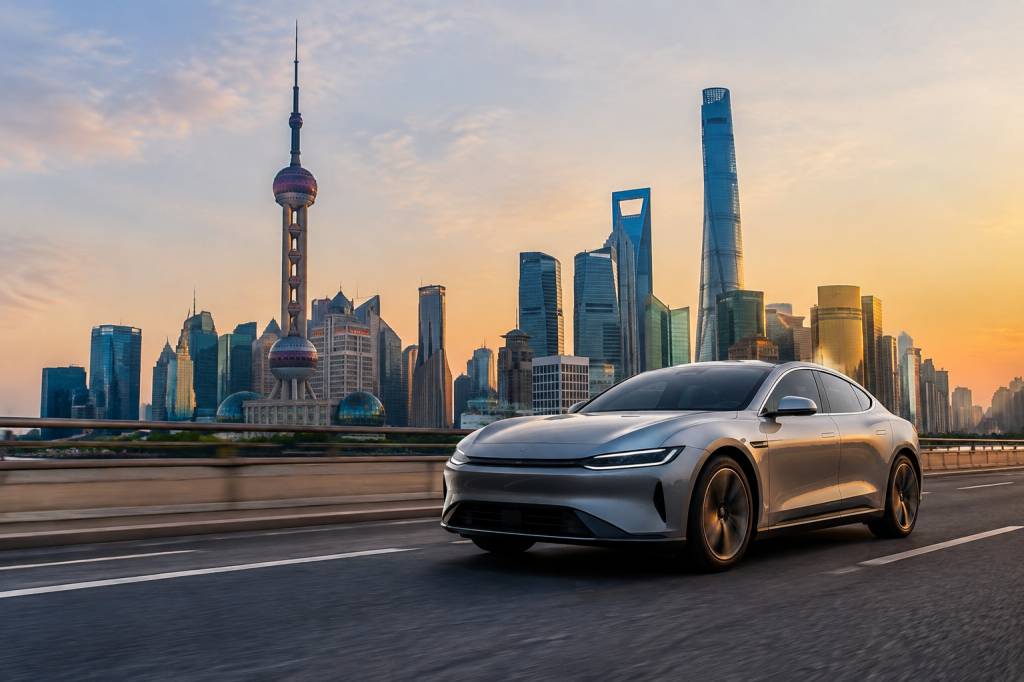
China is no longer simply the world’s largest car market. It has become one of the main steering wheels of the global automotive industry. What happens in Shanghai, Shenzhen, Chongqing or Beijing now reaches showrooms in Europe, reshapes investment plans in Detroit and influences the technology fitted to cars almost everywhere.
For decades, international manufacturers entered China to sell vehicles and learn from local demand. Today, the direction of travel is changing. Chinese brands are expanding abroad, battery technology is becoming a strategic weapon, software is moving to the center of the driving experience and price competition is forcing every automaker to rethink its road map.
So, what are the key trends emerging from China’s automotive news cycle? Buckle up. The answer involves electric motors, artificial intelligence, geopolitics and more than a little old-fashioned horsepower.
China remains the world’s electric vehicle powerhouse
The most visible trend is the extraordinary growth of electric vehicles. China has built a complete ecosystem around electrification, including battery production, raw materials processing, charging infrastructure, vehicle assembly and consumer financing.
That ecosystem gives Chinese manufacturers a major advantage. A company developing an electric vehicle in China can often work with local battery suppliers, software specialists and component manufacturers within a highly concentrated industrial network. This reduces development time and allows brands to update products quickly.
Battery electric vehicles are only part of the story. Plug-in hybrid and extended-range models have also gained popularity, particularly among drivers who want electric commuting without worrying about long-distance charging. In large cities, these vehicles can deliver a quiet, low-emission daily drive while retaining the flexibility of a combustion engine or range-extending generator.
This variety is important because the transition to electric mobility is not identical in every market. Urban drivers with access to home or workplace charging may choose a fully electric model. Buyers covering long distances may prefer a plug-in hybrid. Chinese automakers are increasingly prepared to offer both solutions on the same platform.
- Battery electric vehicles are expanding across passenger cars, buses and commercial fleets.
- Plug-in hybrids and extended-range vehicles are attracting customers concerned about charging access.
- Fast-charging networks are becoming a crucial part of the ownership experience.
- Battery costs and local supply chains continue to influence vehicle pricing.
Battery supply chains are becoming a strategic battlefield
The modern electric car is often described as a computer on wheels. That is true, but without a battery it remains a very expensive piece of furniture. China’s influence over battery production has therefore become one of the most important issues in automotive business news.
Chinese companies have developed enormous manufacturing capacity for lithium-ion batteries. They are also investing in different chemistries, including lithium iron phosphate, commonly known as LFP. Compared with some nickel-rich batteries, LFP technology can offer lower costs, strong durability and improved thermal stability, although energy density may be lower.
Battery manufacturers are also working on faster charging, improved cold-weather performance and new cell designs. The goal is simple: make electric vehicles easier to use, less expensive to build and less intimidating for drivers who still associate charging with a lengthy coffee break.
At the same time, governments and automakers outside China are trying to reduce their dependence on Chinese supply chains. New factories are being announced in North America, Europe and other regions. However, creating a complete battery ecosystem requires more than assembling cells. It involves mining, refining, chemical processing, manufacturing expertise and recycling capacity.
This is where the economic stakes become particularly high. Battery production is not just an industrial activity; it is a source of technological influence. Countries able to control the supply chain can affect vehicle prices, production schedules and the speed of electrification.
Chinese brands are moving from value players to global challengers
For many years, Chinese carmakers were associated mainly with affordable vehicles designed for the domestic market. That image is becoming outdated. Brands such as BYD, Geely, SAIC, NIO, XPeng and Great Wall Motor are developing products aimed at international customers, with increasingly sophisticated design, technology and performance.
BYD has become a particularly visible example. Its portfolio covers compact city cars, family SUVs, premium vehicles and commercial models. The company’s strength comes from its vertical integration, allowing it to manufacture or control many key components, including batteries and electric drive systems.
Other manufacturers are taking different routes. Some focus on premium electric vehicles and advanced driver assistance. Others target mainstream buyers with aggressively priced hatchbacks and SUVs. Several brands are also using sub-brands to separate affordable models from more luxurious products, a strategy familiar to established manufacturers around the world.
The international expansion is not limited to exports. Chinese companies are considering or building manufacturing facilities in overseas markets. Local production can reduce logistics costs, improve access to regional incentives and help brands respond to tariffs or trade restrictions.
For consumers, this growing competition could be positive. More choice usually means better equipment, faster innovation and stronger pressure on pricing. For traditional manufacturers, however, the arrival of agile competitors creates a serious question: can a century-old industrial structure move as quickly as a company born in the software and battery era?
Price competition is reshaping the automotive business
China’s domestic car market has become intensely competitive. Manufacturers are launching new models at remarkable speed, updating existing vehicles frequently and reducing prices to attract buyers. This environment has created a kind of automotive pressure cooker: useful for innovation, uncomfortable for profit margins.
Discounts and price cuts can help consumers, but they also create risks for manufacturers and dealerships. Lower prices may reduce the value of used vehicles, frustrate customers who purchased a model shortly before a reduction and make it harder for brands to maintain healthy margins.
The pressure is particularly strong in the electric vehicle sector. As battery technology becomes more affordable and production scales up, companies are expected to pass some of those savings to customers. Yet electric vehicles still require significant investment in software, factories, research and charging services.
This creates a delicate balancing act. Automakers need volume to lower costs, but excessive discounting can weaken profitability. A vehicle may be moving quickly off the showroom floor while the finance department quietly reaches for a stronger coffee.
The impact is already being felt beyond China. European, Japanese, Korean and American manufacturers are reviewing their product strategies, production costs and supply chains. Some are developing lower-cost platforms. Others are forming partnerships to share battery technology, software or manufacturing capacity.
Software is becoming a core selling point
Another major trend in Chinese automotive news is the rapid integration of software into vehicle development. Chinese consumers have shown strong interest in connected services, large infotainment screens, voice assistants and frequent over-the-air updates.
In many new Chinese vehicles, the cabin feels closer to a mobile technology product than to a traditional automobile. Drivers may control climate settings, navigation and entertainment through voice commands. Displays can offer online services, real-time traffic information and personalized interfaces.
Advanced driver assistance systems are also becoming more common. Cameras, radar and other sensors help vehicles maintain lanes, manage traffic and assist with parking. Some premium models use more sophisticated sensor suites, including lidar, to improve perception in complex environments.
That does not mean the car is ready to drive everywhere without supervision. Marketing language can sometimes make driver assistance sound more autonomous than it actually is. The driver remains responsible, and the difference between assistance and autonomy is not a detail—it is the difference between convenience and a very bad afternoon.
Chinese technology companies are increasingly partnering with automakers, while some manufacturers are developing software internally. This collaboration is changing the traditional automotive supply chain. The most important partner may no longer be only the company producing the gearbox or suspension system, but also the firm developing the operating system and artificial intelligence.
New vehicle architectures are accelerating development
Chinese manufacturers are investing heavily in modular platforms designed for multiple body styles and powertrains. These architectures can support sedans, crossovers, sport utility vehicles and sometimes commercial models with shared components.
Electric platforms make this flexibility easier in several ways. Batteries can be positioned low in the floor, while motors require fewer mechanical connections than combustion engines. Designers gain more freedom with interior space, wheelbase and body proportions.
Some companies are also experimenting with cell-to-pack or cell-to-body battery structures. These approaches reduce unused space and can improve packaging efficiency. The result may be more cabin room, greater range or a lower vehicle roofline without sacrificing battery capacity.
Speed is another advantage. A modular architecture allows brands to launch several related products without engineering every vehicle from scratch. In a market where customer expectations and technology change rapidly, development time can make the difference between leading the pack and watching its taillights disappear.
Charging infrastructure is expanding, but the user experience still matters
Electric vehicle adoption depends on more than battery range. Drivers need reliable charging, clear pricing and stations that are available when they arrive. China has invested heavily in public charging infrastructure, including urban stations, highway corridors and high-power chargers.
Fast charging is becoming an important differentiator between models. Some manufacturers are promoting systems capable of adding significant range in only a few minutes under ideal conditions. These claims depend on battery temperature, charger capability and grid availability, but the direction is clear: charging speed is becoming as important as fuel economy once was.
Battery swapping is another solution being explored by some Chinese companies. Instead of waiting for a battery to recharge, a depleted pack can be replaced with a charged one at a dedicated station. The method requires standardized systems and substantial infrastructure investment, but it can appeal to taxi operators, fleet managers and drivers covering high mileage.
Meanwhile, smart charging may help manage demand on the electricity grid. Vehicles could charge when renewable energy is plentiful or electricity prices are lower. In the future, cars may also send energy back to buildings or the grid, transforming parked vehicles into small mobile energy reserves.
Export growth is meeting geopolitical resistance
Chinese vehicle exports have increased significantly, but international expansion is not happening in a frictionless environment. Governments in Europe, North America and elsewhere are examining the impact of imported electric vehicles on local manufacturers, employment and supply-chain security.
Tariffs, investigations, local-content rules and subsidy regulations can all influence where a vehicle is produced and how much it costs. A model that is highly competitive in one market may become considerably more expensive after duties and logistics are included.
These political decisions are reshaping corporate strategies. Chinese automakers may respond by building factories abroad, partnering with local companies or focusing on markets with fewer trade barriers. Established manufacturers, meanwhile, are lobbying for industrial support and investing in regional battery production.
The result is a more fragmented global market. The automobile was once a symbol of international standardization, with the same model sold across many countries. The electric era may produce more regional versions, different software functions and separate supply chains.
Commercial vehicles and mobility services are part of the transformation
The Chinese automotive revolution extends beyond private cars. Electric buses, delivery vans, taxis and heavy-duty trucks are becoming important areas of development. Fleet operators can benefit from lower energy and maintenance costs, especially when vehicles follow predictable routes and return to a depot for charging.
Urban logistics is particularly suitable for electrification. A delivery van covering the same city routes every day does not need the same range flexibility as a family vehicle crossing a continent. This makes commercial fleets a practical testing ground for batteries, charging systems and connected fleet management.
Ride-hailing and autonomous mobility services are also receiving attention. Several technology companies and automakers are testing robotaxis in controlled areas. These projects remain limited and face regulatory, safety and public-acceptance challenges, but they demonstrate how transportation is evolving from vehicle ownership toward mobility services.
The big question is whether consumers will continue to see the car primarily as a personal possession—or increasingly as a subscription, a platform or a service. The answer may differ between cities, generations and income groups.
What these trends mean for drivers worldwide
China’s automotive developments will influence drivers far beyond its borders. Buyers can expect more electric models, quicker software updates, larger screens and stronger competition on equipment and price. Traditional manufacturers will need to improve their digital services while keeping reliability, safety and after-sales support at the center of the ownership experience.
There will also be trade-offs. Faster product cycles may make vehicles feel technologically old sooner. Data privacy and cybersecurity will become more important as cars collect information and connect to online services. Repair networks will need new skills, particularly for high-voltage systems and software diagnostics.
For the global industry, the central lesson is straightforward: China is not merely following the automotive transition; it is helping define its rhythm. The brands that succeed will likely be those capable of combining efficient production, competitive batteries, intuitive software and a clear understanding of local customers.
The next chapter of the car industry is already being written, and its dashboard is glowing with Chinese characters, electric range estimates and software update notifications. Whether established manufacturers can keep pace remains one of the most fascinating stories in automotive business. One thing is certain: the global race has shifted into a higher gear, and the old combustion engine is no longer the only power under the hood.