


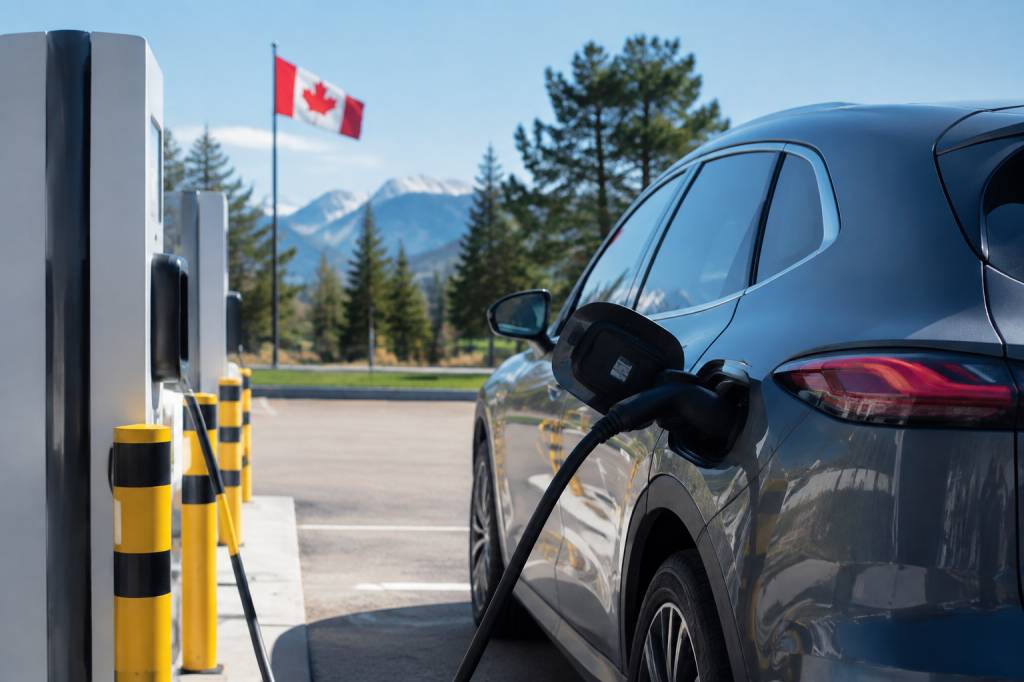
Canada’s automotive market is shifting gears. The familiar ingredients are still on the road—pickup trucks, family SUVs, long commutes and a strong appetite for practical transportation—but the industry is being reshaped by electrification, trade policy, affordability pressures and a race to build the factories of tomorrow.
From Ontario assembly lines to Quebec battery plants, Canada is becoming a more important piece of the North American automotive puzzle. Yet the road ahead is not perfectly smooth. High vehicle prices, charging gaps and changing consumer habits are forcing automakers, governments and buyers to rethink what mobility should look like.
So, what are the key trends shaping Canada’s automotive industry right now? Buckle up. The market is moving quickly.
Electric vehicles are moving from niche to strategy
Electric vehicles are no longer a futuristic subplot in Canada’s automotive story. They are now central to the plans of nearly every major manufacturer. Battery-electric vehicles, plug-in hybrids and conventional hybrids are appearing across more segments, from compact hatchbacks to full-size SUVs and heavy-duty trucks.
Canada’s federal policy has played a major role in that transition. The government has established targets intended to increase the share of zero-emission vehicles sold over the coming decade, while purchase incentives and provincial programs continue to influence demand. Quebec and British Columbia remain among the strongest markets for EV adoption, supported by consumer incentives, cleaner electricity grids and more developed charging networks.
But the Canadian market is not uniform. A driver in downtown Montreal may view an EV differently from someone living several hours outside Thunder Bay or Edmonton. Winter temperatures, long distances and limited public charging can make battery range feel more important than a glossy brochure suggests.
Cold weather is particularly relevant. Low temperatures can reduce an EV’s usable range and increase energy consumption for cabin heating. Modern thermal-management systems have improved considerably, but physics remains stubborn. Even the smartest software cannot negotiate with January forever.
For many Canadian buyers, hybrids may offer the most practical bridge. Models such as the Toyota RAV4 Hybrid, Honda CR-V Hybrid and Ford Maverick Hybrid combine fuel savings with familiar refuelling habits. They may not receive the same attention as a silent battery-powered flagship, but they fit the realities of drivers who want efficiency without planning every trip around a charging station.
Battery manufacturing is becoming an industrial priority
The most important EV development in Canada may not happen in a dealership showroom. It is happening behind factory gates, where billions of dollars are being directed toward batteries, cathode materials and electric-vehicle components.
Ontario has attracted major investments from global manufacturers and battery companies, strengthening its position as Canada’s automotive manufacturing hub. Quebec, meanwhile, has been building an ecosystem around critical minerals, battery materials and clean-energy production. These projects are designed to create more than assembly jobs. They aim to establish a complete supply chain, from mineral processing to battery production and vehicle manufacturing.
This strategy matters because batteries represent one of the most valuable and technically complex parts of an electric vehicle. Relying entirely on imported cells can expose manufacturers to shipping disruptions, geopolitical tension and sudden cost increases. Producing more components in North America gives automakers greater control over supply and helps vehicles qualify for regional trade incentives.
There is also a broader economic argument. Canada has significant resources of lithium, nickel, cobalt and graphite—materials that play an important role in battery production. The challenge is turning geological potential into a competitive, responsible and efficient industrial network.
That means faster permitting, reliable infrastructure, skilled workers and a clear environmental framework. Digging up minerals is only one part of the equation. Processing them, transporting them and integrating them into a high-tech supply chain is where the real engineering—and much of the economic value—resides.
North American trade is influencing every major decision
Canada’s auto industry is deeply connected to the United States and Mexico. Vehicles, engines, batteries and components can cross borders several times before a finished product reaches a customer. This integration has made North America highly competitive, but it also means that trade policy can affect the price and availability of a vehicle almost overnight.
The Canada-United States-Mexico Agreement, commonly known as CUSMA or USMCA in the United States, remains a critical framework for the industry. Rules concerning regional content, labour standards and battery materials influence where manufacturers build vehicles and source components.
Recent discussions around tariffs on Chinese-made electric vehicles have added another layer of uncertainty. Canada has sought to protect domestic manufacturing and align its approach with the United States, while critics argue that fewer low-cost EV options could slow consumer adoption. The debate is not merely political theatre; it has direct consequences for showroom choice and pricing.
Chinese automakers have become major global players, particularly in electric vehicles. Their expansion into Western markets has raised concerns about subsidies, data security, industrial competition and the long-term health of domestic manufacturing. At the same time, their products have demonstrated that affordable EVs are technically possible when supply chains and production volumes are optimized.
For Canadian consumers, the trade question is simple in theory but complicated in practice: should the market prioritize lower prices today or protect the industrial capacity needed to build vehicles at home tomorrow?
Vehicle affordability is putting buyers under pressure
Perhaps the most immediate issue for Canadian drivers is not the transition to electric power. It is the rising cost of owning almost any new vehicle.
New-vehicle prices increased significantly in recent years due to supply shortages, higher production costs, expensive materials and stronger demand for larger, better-equipped models. Interest rates have added another obstacle. A monthly payment that once seemed manageable can now stretch a household budget like an overworked timing belt.
Trucks and SUVs continue to dominate Canadian sales, but their popularity comes with a financial trade-off. Larger vehicles generally use more material, carry higher insurance costs and can be expensive to fuel. Even compact SUVs, once marketed as affordable alternatives to sedans, are increasingly equipped with premium technology packages that push transaction prices upward.
Automakers are responding with a wider range of financing offers, entry-level trims and smaller models. However, genuinely affordable vehicles remain limited in Canada compared with some other markets. Sedan and hatchback choices have declined, leaving buyers with fewer inexpensive options.
The used-car market has therefore become strategically important. A carefully selected pre-owned hybrid can deliver impressive fuel savings without the price of a new EV. Used EVs may also become more attractive as lease returns increase and battery warranties provide additional reassurance.
Before buying, shoppers should examine more than the sticker price. Useful questions include:
The cheapest vehicle to purchase is not always the cheapest vehicle to own. The odometer has a way of revealing the truth.
Charging infrastructure must catch up with consumer ambition
Canada’s EV sales cannot grow smoothly without a stronger charging network. Public charging stations have expanded, but availability remains uneven between provinces and communities. Major corridors are improving, while rural and remote areas often face longer gaps between reliable fast chargers.
Home charging remains the most convenient solution for many EV owners. A Level 2 charger can replenish a vehicle overnight, transforming the daily routine from “find a station” to “plug in when you arrive.” The difficulty is that not every Canadian driver has access to a private garage or electrical panel capable of supporting a charger without upgrades.
Apartment residents and condominium owners face additional challenges. Installing chargers in shared parking areas requires approval, investment and a fair way to divide electricity costs. Without solutions for multi-unit housing, EV adoption risks favouring homeowners while leaving many urban residents in neutral.
Fast-charging reliability is equally important. A station that is occupied, out of service or difficult to activate can quickly turn a confident road trip into an unscheduled coffee break. Network operators are under pressure to improve uptime, payment systems and customer support.
For long-distance travel, battery technology is evolving too. Vehicles with larger packs, faster charging and better thermal management are making electric road trips more practical. Still, Canada’s distances are vast. An EV that works perfectly for a Toronto commute may require more planning on a winter journey through the Prairies.
Automakers are betting on trucks, SUVs and electrified utility
Canadian buyers have a clear preference for utility. Pickup trucks and SUVs remain essential to manufacturers’ business plans, which explains why electrification is increasingly arriving in rugged packaging.
Electric pickup trucks promise instant torque, quiet operation and the ability to power tools, equipment or even a home during an outage. Models such as the Ford F-150 Lightning and other electric truck offerings have demonstrated the potential, but towing remains a serious consideration. Pulling a heavy trailer can reduce range dramatically, especially in cold weather.
That does not mean electric trucks are a failure. It means buyers must match technology to usage. A driver who tows occasionally may find an electric truck extremely capable. Someone who hauls a trailer hundreds of kilometres through winter conditions may prefer a hybrid or conventional powertrain until charging infrastructure and battery density improve further.
Automakers are also expanding hybrid technology in three-row SUVs and family crossovers. These vehicles provide a useful balance: lower fuel consumption in urban driving, familiar refuelling on road trips and enough space for Canadian lifestyles that often involve sports gear, camping equipment and one suspiciously large collection of winter coats.
Manufacturing jobs are changing, not disappearing overnight
Electrification will alter automotive employment, but the transformation is more complex than a simple shift from “jobs” to “no jobs.” Electric vehicles generally require fewer moving parts than internal-combustion vehicles, which can reduce demand for certain engine and transmission operations.
At the same time, battery plants, software development, power electronics, charging infrastructure and advanced manufacturing are creating new opportunities. Workers will need training in high-voltage systems, robotics, data analysis and battery safety.
Ontario’s traditional automotive regions are already adapting. Assembly plants are investing in flexible production lines capable of building vehicles with different powertrains, while suppliers are seeking contracts in battery components and lightweight materials.
The transition will not be painless. Small suppliers that depend heavily on conventional engine components may face major pressure. Government support, retraining programs and long-term investment planning will determine whether the shift produces a stronger industrial base or leaves parts of the supply chain behind.
Software is becoming part of the vehicle’s identity
Today’s vehicles are increasingly defined by software. Over-the-air updates can improve driver assistance, infotainment and energy management without requiring a dealership visit. Digital dashboards, connected services and subscription-based features are becoming common across the market.
This creates opportunities and frustrations in equal measure. A software update can improve a vehicle after purchase, but consumers are also being asked to pay recurring fees for features that were once included in the original price. Heated seats behind a subscription? That idea may leave more than the cabin feeling cold.
Cybersecurity and privacy are also becoming central concerns. Connected cars collect information about location, driving patterns and vehicle performance. Manufacturers must protect that data while explaining clearly how it is used.
Advanced driver-assistance systems are another growing trend. Adaptive cruise control, lane-centering technology and automatic emergency braking can reduce fatigue and help prevent collisions. However, these systems are not autonomous driving. Drivers remain responsible and must stay attentive, even when the vehicle is doing a remarkable amount of work.
What Canadian buyers should watch next
The Canadian automotive market will likely remain highly competitive, with technology, affordability and policy pulling in different directions. Consumers should watch several developments closely:
Canada is not choosing between a purely electric future and a return to traditional engines. The market is moving through a mixed phase where hybrids, EVs, efficient gasoline vehicles and improved public transit will all play roles.
For manufacturers, the challenge is to innovate without pricing ordinary buyers out of the market. For governments, it is to support clean transportation while protecting jobs and industrial competitiveness. For drivers, it is to choose technology that fits real life—not just the most impressive specification sheet.
The next few years will reveal which companies can balance sustainability, practicality and profitability. One thing is certain: Canada’s automotive industry is no longer simply building cars. It is rebuilding the entire ecosystem around how those cars are powered, produced, financed and driven.