Autonews Ford: latest models, business news, and industry updates
Autonews Ford: latest models, business news, and industry updates
Ford is navigating one of the most important turns in its history. The blue oval still has a firm grip on America’s roads, from the F-Series workhorse to the Mustang coupe, but the industry around it is changing at full throttle. Electric vehicles, hybrid powertrains, software, supply chains and tougher global competition are reshaping the business faster than a Mustang can clear a highway on-ramp.
For drivers, that transformation is visible in Ford’s latest models. For investors and industry watchers, it appears in a different form: revised EV plans, new battery strategies, pressure on margins and a renewed focus on profitable vehicles. So, what is happening inside Ford right now, and which models deserve the most attention?
Ford’s current strategy: three businesses, one blue oval
Ford has organized its operations around three major divisions: Ford Blue, Model e and Ford Pro. The structure is designed to separate the company’s traditional strengths from its electric and commercial ambitions.
-
Ford Blue focuses on gasoline and hybrid passenger vehicles, including the Mustang, Bronco, Explorer and F-Series.
-
Model e develops electric vehicles, connected technology and the digital services surrounding them.
-
Ford Pro serves commercial customers with vans, pickups, fleet management tools and software.
It is a sensible approach on paper. Ford can continue generating cash from combustion and hybrid vehicles while investing in electrification and growing its commercial ecosystem. In automotive language, the company is trying to change the engine without stopping the car.
The challenge is equally clear: Ford must finance the electric transition while making its legacy business more efficient. EV demand has continued to grow, but adoption has not always matched the aggressive forecasts made earlier in the decade. High interest rates, charging concerns and pricing pressure have made many buyers hesitate before making the switch.
The Ford F-150 remains the center of gravity
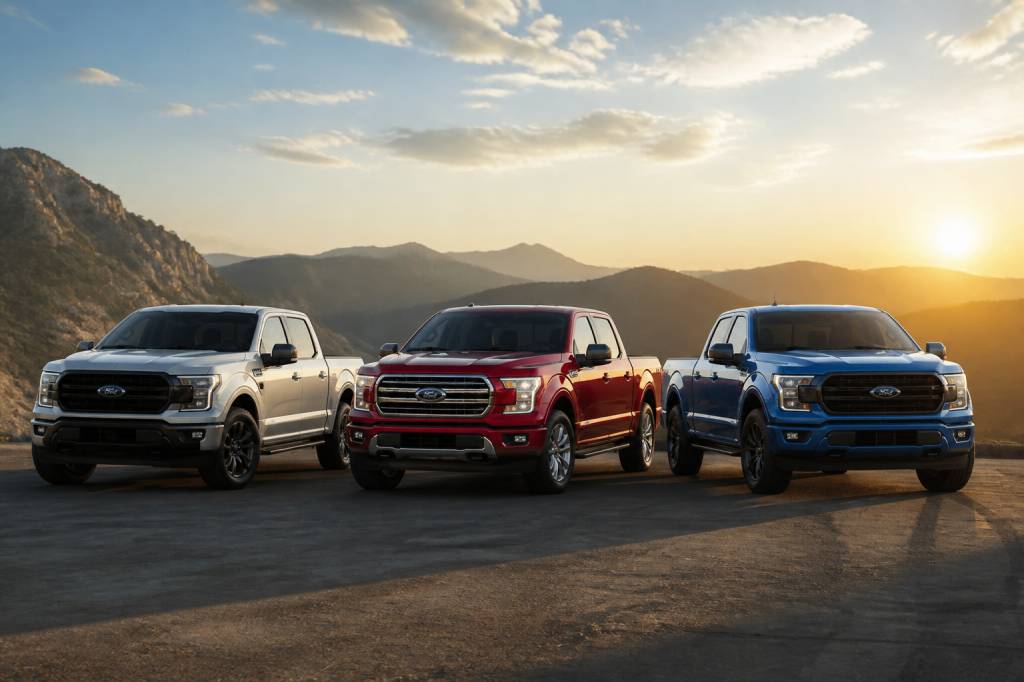
The F-150 is still Ford’s most important nameplate and one of the most influential vehicles in the American market. Its latest updates continue to focus on capability, technology and powertrain variety rather than dramatic visual change.
The current F-150 lineup offers gasoline engines, hybrid assistance and the all-electric F-150 Lightning. That broad range reflects the reality of today’s market: some customers want zero-emission driving, while others need long-distance towing, quick refueling or maximum payload flexibility.
The F-150 Lightning brings instant electric torque, a spacious front trunk and a smooth driving experience that feels almost too quiet for a truck. It is particularly convincing as a daily vehicle and a worksite companion, especially for owners who can charge at home. However, towing heavy trailers over long distances remains more demanding because range can drop significantly under load.
Ford has adjusted its electric truck strategy in response to market conditions. The company has slowed certain EV investment timelines while placing more emphasis on hybrid technology and commercially viable products. That does not mean the electric F-150 is disappearing. It means Ford is treating it as part of a wider portfolio rather than betting the entire pickup business on one powertrain.
Meanwhile, the traditional F-150 continues to evolve with practical features such as onboard power, advanced driver assistance and configurable storage. The formula is familiar, but Ford knows that familiarity sells. When a truck has been the market leader for decades, radical change can be riskier than a muddy worksite.
Mustang: the sports car that refuses to retire
The seventh-generation Mustang proves that Ford still believes in the emotional side of driving. In a market increasingly filled with crossovers and silent electric vehicles, the Mustang keeps its long hood, rear-wheel-drive layout and performance character.
The latest Mustang is available with a turbocharged four-cylinder engine or a naturally aspirated V8, depending on the version. The Dark Horse variant adds more aggressive chassis tuning, performance equipment and a stronger visual attitude. It is not merely a car that looks fast in a parking lot; it is designed to reward drivers who enjoy steering with intent.
Inside, Ford has introduced a more digital cockpit with large screens and configurable displays. Some enthusiasts may miss the simplicity of older Mustangs, but the new interface brings modern connectivity and performance information into view. The result is a car that mixes analog muscle with digital instrumentation—a little bit of nostalgia, a little bit of Silicon Valley.
The Mustang Mach-E occupies a different lane. Despite its name, it is an electric crossover rather than a traditional coupe. Its quick acceleration, spacious cabin and relatively practical shape have made it an important part of Ford’s EV portfolio. Recent updates have focused on charging improvements, software and equipment rather than reinventing the model.
That dual identity is strategically useful. The Mustang name can attract customers to both performance gasoline vehicles and electric mobility. Whether every purist accepts the Mach-E as a “real” Mustang is another question. Car enthusiasts have debated less important matters with the intensity of a championship final.
Bronco and Ranger: Ford’s adventure portfolio grows
The reborn Bronco has become one of Ford’s strongest modern success stories. Its combination of removable body panels, off-road hardware and retro-inspired design gives it a clear personality in a crowded SUV market.
Available in several configurations, the Bronco can be tailored for everyday use or serious trail work. Features such as terrain management modes, advanced four-wheel-drive systems and removable doors help it stand apart from conventional family SUVs. It is not the quietest or most refined vehicle in the segment, but that is part of the appeal. The Bronco feels like it wants to get its tires dirty.
The Bronco Sport targets buyers who want a smaller and more manageable crossover with outdoor styling. It is less extreme than the full-size Bronco, but easier to live with in urban environments. For many customers, that balance may be more useful than maximum rock-crawling ability.
The Ranger pickup has also returned with a modernized platform, improved technology and stronger capability. Positioned below the F-150, it offers a practical alternative for buyers who do not need a full-size truck. The Ranger Raptor adds a more serious performance edge, with suspension hardware and off-road tuning designed for high-speed desert-style driving.
This expansion is important for Ford because trucks and SUVs remain central to its profits. The company can offer customers multiple entry points: Maverick for compact pickup buyers, Ranger for midsize users, F-150 for full-size needs and Super Duty for heavy-duty work. It is less a lineup than a carefully arranged ladder of torque.
Maverick and hybrid technology bring efficiency closer to reality
The Ford Maverick has shown that electrification does not always need to arrive in the form of a large, expensive battery pack. Its available hybrid powertrain combines a gasoline engine with electric assistance and is aimed at buyers who want better fuel economy without changing their entire driving routine.
Its compact dimensions, useful bed and accessible price position have helped it attract urban drivers, first-time truck owners and customers who previously would have chosen a small SUV. The Maverick is not designed to replace a Super Duty on a construction site, but that is hardly a failure. A vehicle should be judged by the job it was built to do.
Hybrid technology is becoming increasingly important to Ford’s broader strategy. It can deliver lower fuel consumption and smoother urban driving while avoiding some of the range and charging concerns associated with a fully electric vehicle. For customers who drive long distances or live in areas with limited charging infrastructure, a hybrid may be the most realistic bridge between conventional power and full electrification.
Ford’s EV business faces a tougher road
Ford’s electric models have demonstrated strong potential, but the financial picture has been more complicated. Electric vehicles require large investments in batteries, software, manufacturing and charging support. At the same time, competition has intensified, forcing manufacturers to reduce prices or add equipment to keep vehicles attractive.
Ford has responded by revising the timing and scale of some EV projects. The company has placed greater emphasis on lower-cost platforms and smaller electric vehicles, while continuing to develop the Mustang Mach-E and F-150 Lightning. This approach reflects a central industry lesson: an electric vehicle may be technologically impressive, but it also needs to make business sense.
Battery production remains a major factor. Ford has worked with battery partners to establish North American manufacturing capacity and benefit from regional incentives. The company must balance cost, supply security, local-content requirements and consumer demand. That is a complicated equation, and the answer cannot be found by simply adding more batteries to the spreadsheet.
Ford is also investing in charging convenience. Access to the Tesla-developed North American Charging Standard network has expanded options for compatible Ford EV owners, reducing one of the major objections to electric ownership. More chargers do not solve every problem, but they make the ownership experience less like planning an expedition and more like planning a weekend trip.
Ford Pro: the quiet powerhouse of the business
While consumer vehicles receive most of the attention, Ford Pro has become a crucial part of the company’s growth story. Commercial customers buy vehicles for productivity, reliability and operating cost—not merely for attractive wheels or a dramatic grille.
The Transit van, E-Transit, F-Series Super Duty and commercial versions of the Ranger and Maverick support businesses ranging from delivery services to construction companies. Ford Pro also offers software and fleet-management services designed to track vehicles, schedule maintenance and monitor energy usage.
The electric E-Transit is particularly significant for urban fleets. Delivery vans often follow predictable routes and return to a central depot, making them more suitable for electrification than long-haul private vehicles. Lower fuel and maintenance costs can become meaningful over thousands of miles, provided charging infrastructure is properly planned.
This recurring software and services revenue could help Ford reduce its dependence on one-time vehicle sales. It also gives the company more information about how commercial vehicles are used in real conditions. In the future, that data may influence everything from vehicle design to maintenance schedules.
Manufacturing, labor and the cost of transformation
Ford’s business updates cannot be separated from manufacturing economics. The transition to EVs requires new plants, battery expertise and different workforce skills, while existing factories must continue producing profitable vehicles.
Labor agreements and wage increases have added pressure to operating costs across the traditional auto industry. At the same time, Ford is competing with manufacturers that may have different cost structures, newer factories or stronger positions in battery supply chains.
Supply-chain resilience has also become a strategic priority. Semiconductor shortages, shipping disruptions and raw-material price swings have shown how quickly production can be affected. Ford, like its rivals, is working to build a more regional and flexible supply network. The days of treating logistics as a background detail are over; the supply chain now sits in the driver’s seat.
What Ford drivers should watch next
Ford’s next phase will be defined by execution. The company has a broad portfolio, but managing that complexity will be essential. Buyers and industry observers should keep an eye on several developments:
-
More hybrid models: Ford is likely to expand hybrid availability as a practical response to customer demand and emissions requirements.
-
Lower-cost EV platforms: Affordable electric vehicles could be more important than premium technology showcases.
-
Charging access: Improvements in public charging and software integration will influence EV adoption.
-
Ford Pro growth: Commercial services and fleet software may become increasingly important to profitability.
-
Product quality and reliability: New technology is valuable only when it works consistently in everyday use.
Ford is not abandoning its traditional strengths, nor is it ignoring the future. The company is attempting something more difficult: keeping profitable trucks, SUVs and performance cars in motion while developing a new electric and software-driven business.
That balancing act will not always be smooth. There will be missed targets, revised launches and more than a few boardroom debates about batteries versus turbochargers. But Ford’s current lineup gives it useful room to maneuver. The F-150, Mustang, Bronco, Ranger, Maverick and Ford Pro vehicles continue to generate attention and revenue, while the electric range opens the door to a changing market.
For drivers, the message is straightforward: Ford’s future will not be defined by one perfect powertrain. It will be shaped by choice. Gasoline, hybrid and electric models will coexist, each suited to different roads, budgets and daily routines. The blue oval is changing lanes—but for now, it has not taken its foot off the accelerator.